
Why you should get a DEXA Bone Density Scan
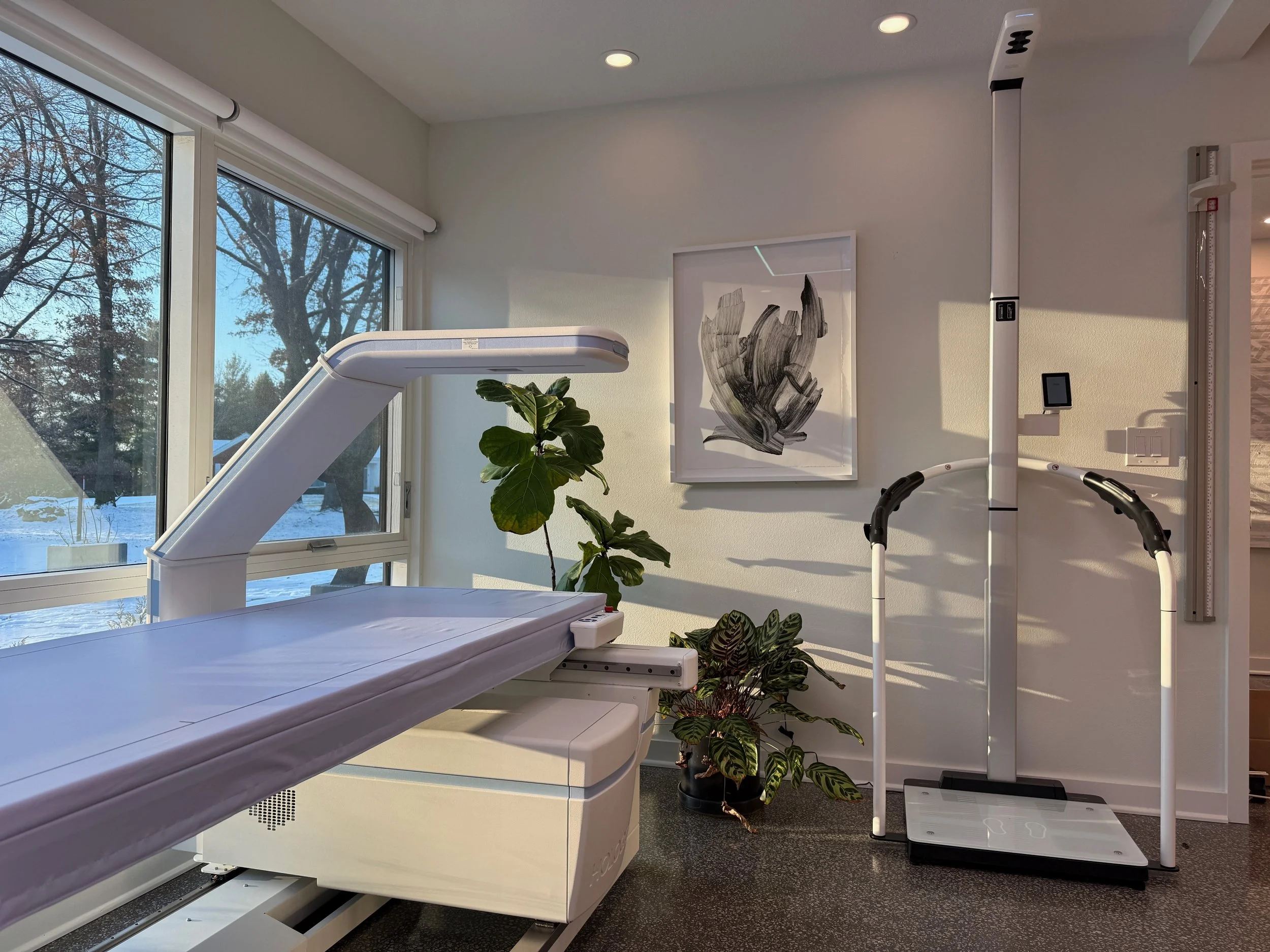
The Hologic DEXA scanner at Abendroth Modern Medicine
ABOUT BONE MINERAL DENSITY
Your peak years for building strong bones are over by age 30 (most of it is before you are even an adult) — and after that, bone loss begins, silently and relentlessly, for the rest of your life. If your bones never reached robust density in your youth, you may already have osteopenia or even osteoporosis — even at a relatively young age. But that doesn’t mean you’re powerless to slow it — or even reverse it.
ABOUT DEXA SCANS
Unless you have a DEXA scan, you won’t know if you have low bone density until you break a bone doing something that doesn’t break healthy bones. DEXA (Dual X-Ray Absorptiometry) is a technology that uses x-rays to determine the density of your bones. Despite using x-rays, the radiation exposure is extremely low — less than you’d receive on a cross-country flight or a day spent walking around a major city.
THE SILENT EPIDEMIC
Our sedentary lifestyles, indoor living, and poor nutrition have created a quiet epidemic of weakened bones. If you’re planning to stay active, travel, and live fully into your later years, don’t wait until a broken hip or other serious fracture forces you to take notice. Find out how your bones stack up now so you can make the right decisions today.
WHY WAITING FOR FREE INSURANCE SCREENING IS A MISTAKE
Insurance will pay for a screening DEXA scan at 65 for women and 75 for men — but by then, decades of valuable time have been lost. While it’s never too late to do something, the sooner we can intervene, the better. In women, bone density plummets after menopause, unless hormone replacement therapy is started. But, that bone loss begins to accelerate even in perimenopause (the years of hormonal fluctuation preceding menopause).
A SMARTER, MORE PERSONALIZED APPROACH TO BONE HEALTH
At Abendroth Modern Medicine, we take a layered approach to restoring and protecting bone health. Every plan is personalized based on your unique biology, risk factors, and preferences — not a one-size-fits-all protocol. Every plan starts with a foundation of targeted nutrition and load-bearing resistance training. Additional strategies may include hormonal therapy (such as testosterone or estrogen replacement), anabolic bone-building medications (like Tymlos or Forteo), bisphosphonates to prevent further loss, or novel peptide therapies for select cases.
AN EXAMPLE CASE
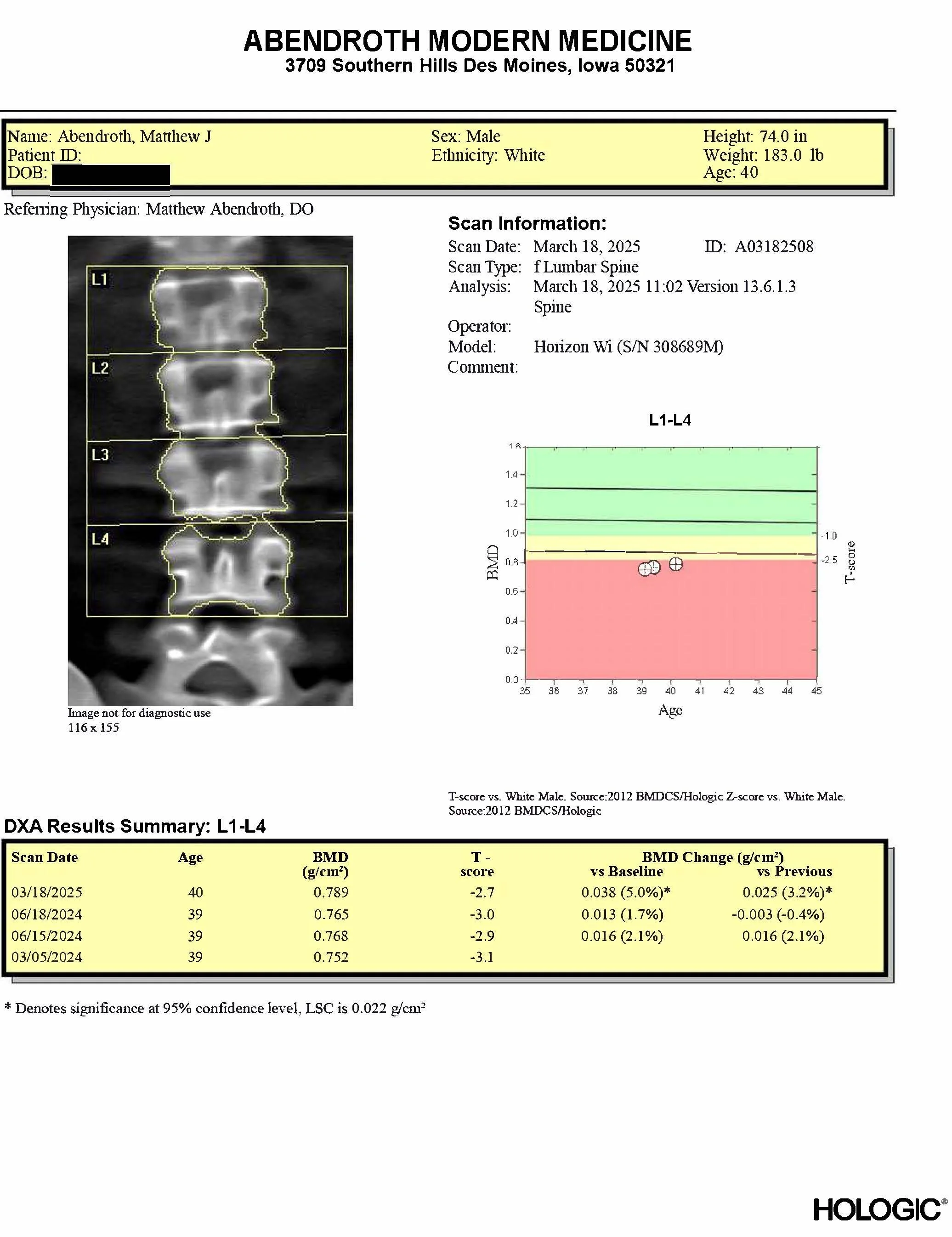
This is my actual bone density scan
MY OWN OSTEOPOROSIS
When I bought the DEXA scanner I would need for this clinic, naturally, the first thing I did was check my own bone density. To my surprise, I discovered that I had osteoporosis, or very low bone mineral density. This is thought to be extremely unusual in a young man, but I have diagnosed it in another man in his 30’s, and have diagnosed osteopenia — the same thing, but less severe — in many other young men and women in their 30’s and 40’s. In the traditional medical model, none of us would have known for decades, while our bones continued to silently weaken. We would find out when a bone broke from minor trauma, or when guidelines said we should be screened — at age 65 to 75, after much more bone had been lost.
Because I found out, I have been able to discover the cause of my osteoporosis and treat it using a multi-pronged approach, and have reversed my osteoporosis, as I have done for my patients.
It’s never too late to act — but the earlier you start, the more options and success you will have. This is why we include a DEXA bone density scan for every patient during your initial Longevity Health Assessment.
